

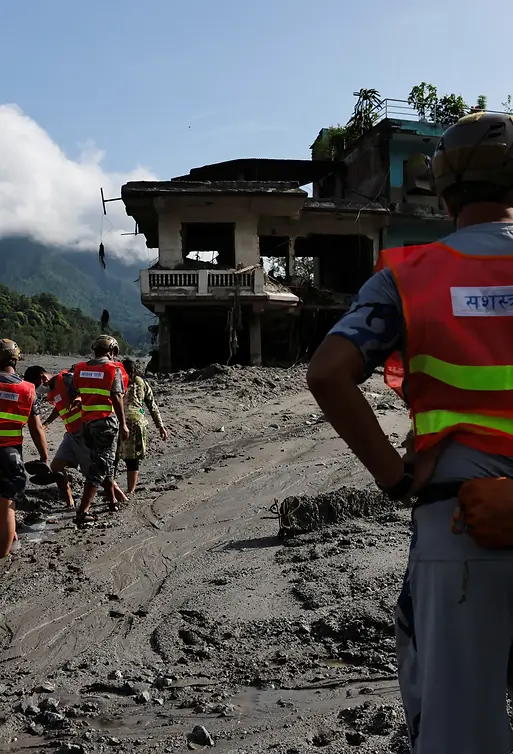
The devastating floods tearing apart communities in Nepal demonstrate the severe and systemic nature of the ongoing global climate crisis created by fossil-fuel extraction and burning. Despite producing less than 0.1% of global greenhouse gas emissions, Nepal bears the brutal frontline impacts of a crisis it did not cause.
The Science of Cascading Impacts
This ongoing calamity highlights a stark climate injustice on the frontlines. The unprecedented devastation is a direct result of higher temperatures in the Himalayan region, which have already destabilised glaciers and amplified extreme precipitation. This combination causes entire river systems to become far more destructive within minutes.
-
Scientists have been warning for a very long time that as the planet warms, we will see more compounding and cascading climate impacts.
-
One incident, whether a geological or climate event, can lead to another, causing a chain reaction, which is exactly what we have seen in Nepal.
-
Across Asia and the Global South, communities least responsible for global heating from oil, gas, and coal expansion are paying the highest price.
A Rigged Financial System
As communities suffer, the mechanisms built to protect them are failing by design. What we are witnessing in Nepal is the deadly consequence of a rigged financial system. The Green Climate Fund's (GCF) seven-year delay to provide vital support against glacial floods is a feature of how international climate finance has been structured by industrialised rich countries. Developed countries have intentionally designed institutions like the GCF to remain inefficient and difficult to access.
Furthermore, pushing large-scale infrastructure in highly vulnerable regions ignores the reality of a warming world. An integrated cost-benefit analysis should take into consideration the probability of seismic activity, Glacial Lake Outburst Floods (GLOFs), cloudbursts, and other possible extreme events, alongside the impact on ecosystem services.
-
A proper Cumulative Impact Assessment must value all these factors and incorporate them as costs in the benefit-cost matrix.
-
If properly assessed, such projects in vulnerable basins would be proven economically, socially, and financially unviable.
The Demand: Mobilize the Loss & Damage Fund Immediately
In response to the catastrophe that struck Nepal on August 26, 2026, immediate diplomatic action is underway to force the international financial system to respond. On September 2, 2026, Board and Alternate Members representing Africa States, Asia Pacific States, and Least Developed Countries submitted a formal letter to the Co-Chairs and Executive Director of the Fund for responding to Loss and Damage (FRLD).
The coalition is urgently demanding:
-
An Extraordinary Board Meeting: A request to convene immediately to consider an urgent and appropriate response to the extreme weather event.
-
Rapid Response Funding: A call for the Board to agree to a provisional set-aside allocation of resources to support rapid response funding for Nepal.
-
Institutional Alignment: A request for the Secretariat to prepare a briefing note on initial loss and damage-related needs and to coordinate with the Government of Nepal's National Designated Authority, UN agencies, and actors already on the ground.
"Nepal is a least developed country... and this event constitutes precisely the kind of climate-related extreme weather events the Fund was established to address." - Official Request to the FRLD Board
This pressure from Global South board members directly supports a prior communication submitted by Nepal's Minister of Finance and Minister of Agriculture, Forests and Environment on August 31, 2026, which requested an immediate response from the Board.
Breaking the Cycle of Destruction
To protect vulnerable communities, we must confront the root cause of climate breakdown and fix a fundamentally broken international finance system.
We need governments to join forces and take urgent, global, and decisive action to end all new fossil fuel expansion and equitably phase out existing production. This transition must be just, well-funded, and secure energy sovereignty through accessible, distributed renewables. Crucially, it must honor the shared responsibility to financially support the survivors on the frontlines by making polluters pay.


